Namecheap

Sunday, 30 June 2013

The best email statistics sources to benchmark your email campaigns in the UK, US, Europe, Asia-Pacific incl Australia

Email marketers often ask “how do our campaigns compare?”. They’re looking for statistics to compare subscriber engagement for open, clickthrough and delivery rates, ideally within their sector.
Fortunately, there are a number of good options to compare email stats. The best are compilations by email marketing service providers who produce statistics across their clients’ campaigns. These are the latest sources I recommend for different locations. As well as my compilation of the latest data, I also recommend Mark Brownlow’s compilation of Email marketing statistics sources. In this post we give the latest 2013 data from different regions. Do let us know of other sources you use for email benchmark stats.

UK Email Statistics

ESP Sign-up Across all industries, the average results Sign-up.To 2013 Email statistics for UK SME email marketing campaigns were:

Across all industries the average results for UK SME email marketing campaigns were:
  • Open rate: 21.47%
  • Click-through rate: 3.16%
  • Unsubscription rate: 0.47%
  • Click-to-open rate: 14.72%
  • Unsubscribe-to-open rate: 2.29%
The 2011 report has a relatively small sample of 500 million emails sent by SMEs during 2010. A larger sample for UK Emails from Epsilon is presented in the European section of this report
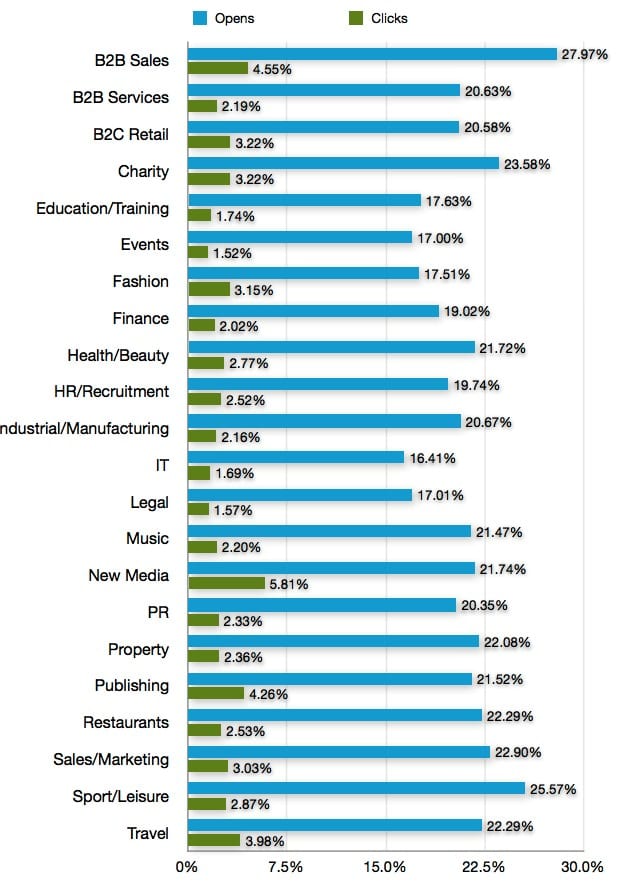
But it’s a useful report since it has the breakdown of opens, clicks and unsubscribes by industry for B2B and B2C markets. This shows the much lower response in some sectors such as Events, Education and Legal services.
Email-marketing-statistics-2013 2


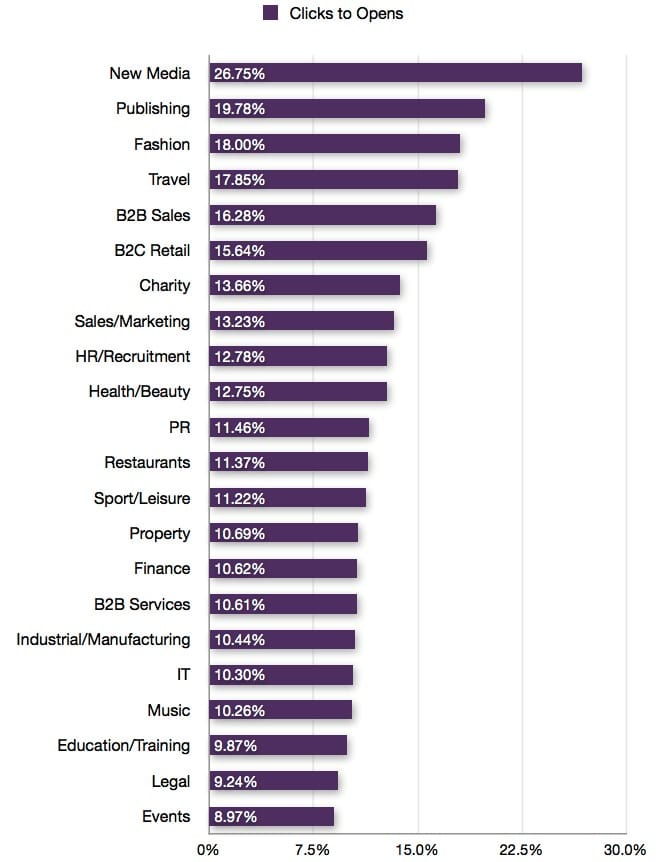
There are also statistics on engagement measured as clicked to open – this info isn’t always available in these types of benchmarks. It’s useful to compare how effective your creative and offers to generate clickthroughs.

Email-open-click-rate-statistics

Finally, the full report also has a sector breakdown on unsubscribe rates. Again a large difference here by sector.

US Email Statistics

Epsilon EUS Emamail Benchmark reports

Epsilon is one of the largest email providers broadcasting worldwide and has regular reports making it one of the best sources.

The Epsilon Email Marketing Research Center has data for North American and European Trends.
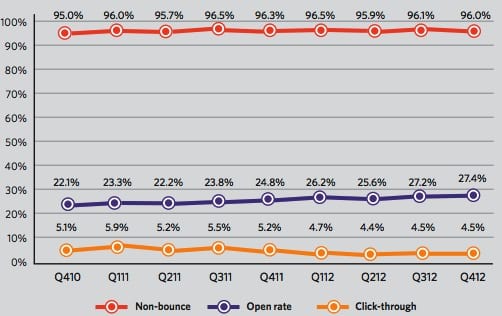
US email campaign data published March 2013 shows that despite some social media marketing specialists occasionally saying that “email marketing is dead”, open and clicks remain stable. That said, marketers are having to work a lot harder through delivering more personalised relevant creative to achieve this and clickthrough rates are lower overall in 2012 compared to 2011.

Open-click-rates


Triggered email response statistics

The Epsilon data set is interesting since it has insight on triggered emails which aren’t usually separated in these types of industry benchmarks. These are often more personalised and occur at an earlier stage in the subscriber relationship before email fatigue has set in – so these are useful for comparing to your welcome emails or abandoned basket emails.
As we would expect, this type of email has higher response – with clickthrough rates twice as high as those from Business-as-Usual (BAU) email marketing.
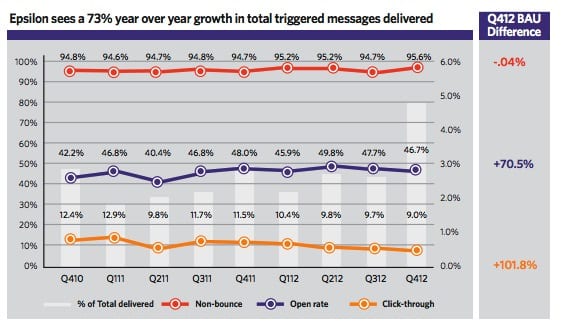
Epsilon triggered email response

A breakdown is also available by sector.
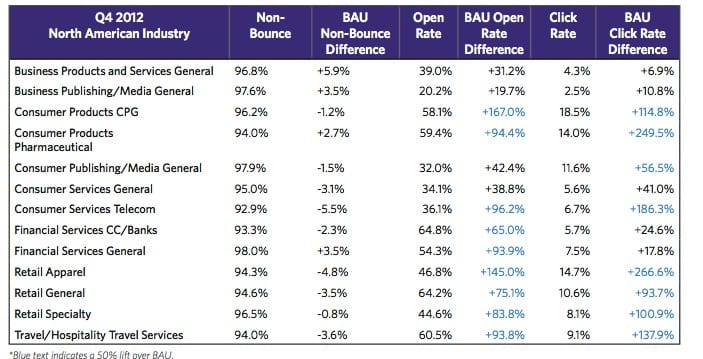
Triggered by sector


European Email Statistics

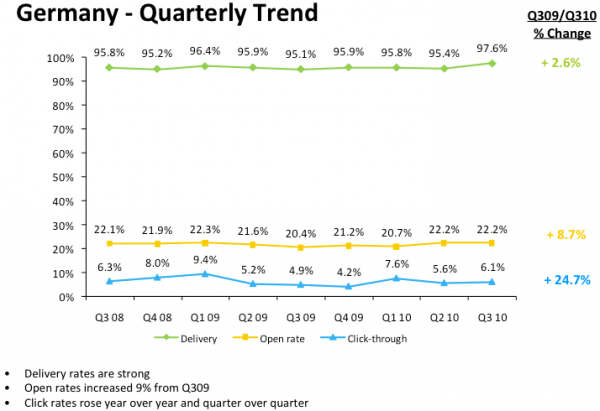
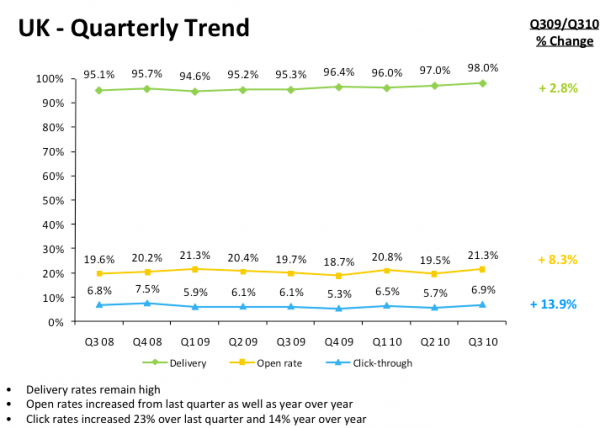
Epsilon is the best source I’m aware for breakdown of email response for European countries – see their EMEA Email Resource Centre. Breakdown by country below is kept for reference although Epsilon haven’t updated this recently.

France Email response trends


Germany Email response trends


UK Email response trends

Asia-Pacific Email Statistics

Epsilon is again a source that can be used here. These sources have been recommended to me via Linked In:
http://www.asiadigitalmarketingyearbook.com/
http://www.powerretail.com.au/special-report/

Australia Email marketing statistics

A 2012 compilation of Email marketing statistics for Australian audiences from Vision 6 showing open rate across a range of sectors – B2B sectors have the highest clickthrough rates.
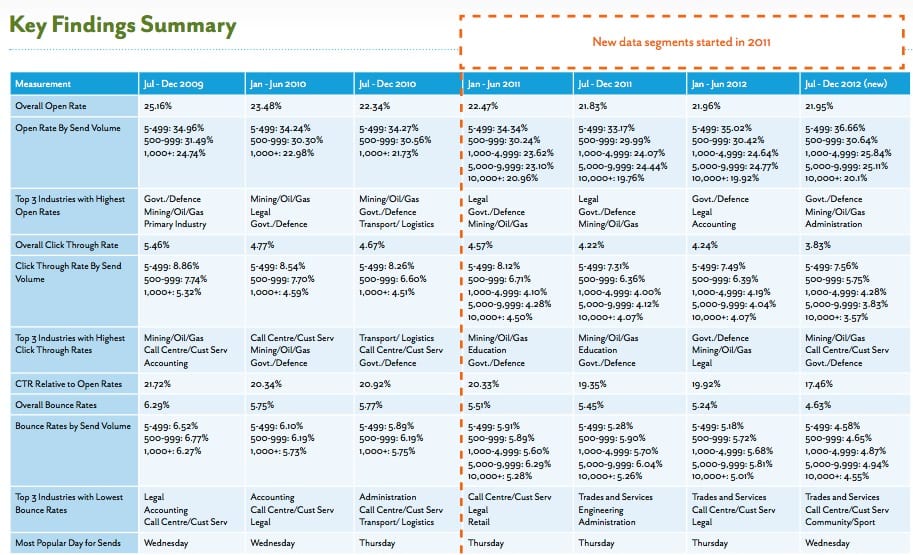


Here is an example of the email industry response data available from Vision 6.
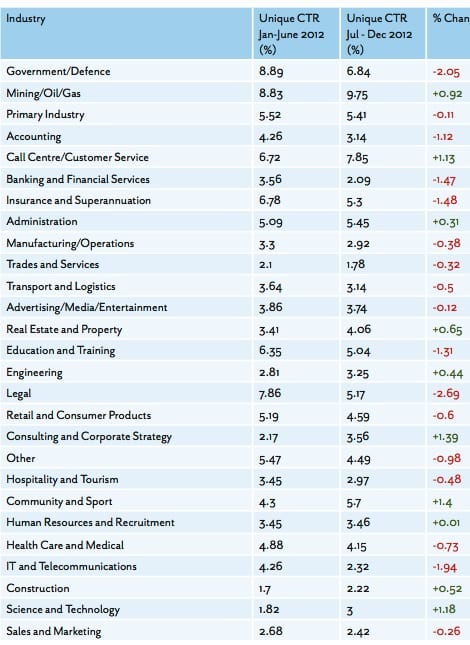

Australia-email-statistics-click-rate-industry

http://www.smartinsights.com/email-marketing/email-communications-strategy/statistics-sources-for-email-marketing/

Friday, 28 June 2013

3 Ways To Optimize YouTube Titles

Elements such as the video title are crucial when it comes to influencing potential viewers’ decision-making. Here are 3 things to keep in mind when creating your YouTube titles.
optimize YouTube titles

Create Powerful Video Titles.

These don’t necessarily have to be clever. They do, however, have to make your potential viewer:
  • Excited
  • Curious
  • Wanting to see more
  • Pick yours over possibly hundreds of similar videos
A powerful title is less than 66 characters long and is keyword optimized.
Something to think about: Adding the word “video”. People often search with the word video when looking for the right YouTube offering
 .video keyword

Let people know what type of video they are looking at.

Use keywords such as:
  • Tutorial
  • How to
  • Review
  • Introduction to
  • Training
  • B2B

Get ideas by looking at other YouTube titles.

Study titles and decide which ones appeal to you. See if you can spot a common denominator for the ones that do appeal. Take note of the viewer count. Figures in the low thousands should be of first interest. What is a common denominator for these titles?
Look at the bad-and-ugly titles too. Which ones only got a handful of viewers? Again, any common denominators in the Titles?
The best YouTube titles combine keywords and catchiness to grab attention from the search engine AND potential watcher’s eyes.

Tuesday, 25 June 2013

What is email marketing?

content amp

To some people, email marketing is synonymous with SPAM. However, a carefully targeted email delivered to a mailing list of interested customers who actually consented to being on your list is perfectly acceptable.

Who do I send the emails to?

Basically you send the emails to anyone in your existing or potential customer base who you think would be interested in what you've got to say. It's important that you have their permission first, of course. This can be gained by asking them to fill out their contact details and clicking a permission tick box when they visit your website or make an online purchase. Narrowing down from everyone who's consented, you can use various tools to target emails more specifically to members of the master list you think would be most receptive. Good data analysis will allow you to change and tailor your campaign while it is ongoing.

What goes in the emails?

There are various different types of email that can be used within the same campaign, and they don't all have to give the hard sell. The first email a customer receives will often be a welcoming message. This can be followed by general newsletters, specific information or announcements on new products and promotional offers such as money-off e-vouchers. Ideally, every email you send should be of some value to its recipient.
Each email should also be actionable in some way. That doesn't mean that everyone should have a 'Buy' button of some sort but at the very least it should contain links to various products and the web address of your main business. Don't forget that you should also include an opt-out or 'Unsubscribe' button for people who don't want to be on the list any more. It's better not to waste your time or theirs on unreceptive addresses.

What are the advantages?

Almost all internet users have an email address, giving email marketing a potentially impressive impact and reach. It's quick and extremely cost effective, and experts like little green plane offer affordable email marketing solutions, services and even training. It works best as part of an integrated campaign with other techniques but email marketing certainly shouldn't be overlooked.

http://bdaily.co.uk/technology/16-04-2013/what-is-email-marketing/


Monday, 24 June 2013

How to raise your email opt-in rate: three CRO case studies on overlays

Overlays, screens that appear on top of a web page a visitor is browsing, are taking over as the most powerful way to gather email opt-ins from new visitors.

Thousands of sites use them, ranging from publishers such as The Motley Fool, to ecommerce sites like Joss & Main, and even Hilary Clinton’s last presidential campaign site.

Generally, a site with an overlay garners up to 400% more email opt-ins than a site that relies on an in-line form will.                                               
To put that another way, if your site’s opt-in form gets a .5% opt-in rate now, adding an overlay could bring you a 4% opt-in rate or higher.
How can you make your overlays get an even better response rate? Happily, overlays are fairly easy to run A/B tests on. 

Here are three examples to inspire you...

Case study #1. Classic headline copy test

Headline copy tests are just as powerful for overlay A/B tests as they are for landing page tests. Plus, they are the easiest tests to run because you often don’t need to get your tech or design team’s help. 
Here’s one Reebok ran for its email opt-in overlay:

Version A                                              Version B

Reebok Version A Reebok Version B

Images from WhichTestWon, copyright protected.


Version B, with the benefit oriented JOIN AND SAVE! headline garnered 40% more email opt-ins than Version A.  Remember, this is a 40% lift in opt-ins from the exact same amount and type of traffic. 
If your email opt-in list could increase by 40% with a simple headline change, wouldn’t you test it now? 
  

Case study #2. Is bigger better for conversions?

An overlay greys-out (or whites-out) the page of the site it’s appearing on top of, so you can see a smidgen of the page below it, around the edges of the offer.  
The question for this test was, how big should your offer be? Generally online bigger is better after all….
Here’s the control overlay from hobby site FaveCrafts:


Favecraft Small

Image from WhichTestWon, copyright protected.


And here’s FaveCrafts’ test version where the offer box is even wider:

FavCraft Large

Image from WhichTestWon, copyright protected.


You’ll notice that both versions had the exact same copy and graphics… even the button size remained the same. The only change was the width of the offer box.  
So which one won?

The thinner one! Beating expectations, the thinner box pulled in 8.8% more email opt-ins than the wider one. 

Case study #3. How quickly should your overlay appear?

Many marketers personally find overlays annoying, so they want to delay them as long as possible into an average visitors’ arrival. 

The theory being that if you give visitors enough time to look around and fall in love with your site, they won’t mind the overlay as much.

Does it work? We ran this timing test on our own site.To put it in perspective, you should know our average new visit stays for 2.27 minutes. We split our new traffic into thirds and ran the exact same overlay to everyone…just at different times after arrival: 15-seconds, 30-seconds and 45 seconds.
Here’s what the overlay looked like (fairly bog standard): 


WTW Overlay Creative

Image from WhichTestWon, copyright protected.


And the winner was… 15 seconds!  Yes, we were surprised. 15 seconds doesn’t seem like a very long time for a visitor to decide if they like your site enough to sign up for your email newsletter.  Obviously our ‘marketers intuition’ was wrong so we’re glad we tested it.

The data: the 15-second timing beat 30-seconds by 11% and it beat 45-second timing by 50%.
So, if we’d gone with 45-second timing, we’d have 50% fewer newsletter readers.

Is faster overlay timing a best practice that will work for your site as well? Only testing can tell.
As the data shows, it’s well worth the test. And, luckily many email service providers (ESPs) make testing overlay timing fairly easy – it’s often functionality that’s included free with the service. But you have to use it.

Friday, 14 June 2013

10 Tips for Stress-Free Outsourcing

If you’re like most entrepreneurs, you have far more to do than you can possibly ever get done. That means if you want to keep growing your business (or want more time for a personal life) you have to get some help. Thankfully, these days you don’t have to spend the time and money hiring full-time, in-house employees. Instead you can outsource specific projects or ongoing basis to any number of virtual service providers. 
  
This can be wonderfully effective – as long as you know how to communicate your needs clearly. Because if you don’t, you’re going to end up spending far too much money and not getting what you needed when you needed it.

To help you have a successful outsourcing experience, below is a list of 10 practical tips that make the process smooth and easy…

1. Create how-to process documents and/or checklists for all recurring tasks in your business.

Having everything documented makes it much easier to outsource those tasks virtually, or even hand them off to an employee or partner. The easiest way to do this is to create these as you do the tasks. The best part is, you only have to create these docs once, versus having to do the task yourself over and over again.

2. Always include a project title in your requests that is clear and descriptive.

This makes it easy to keep your tasks organized at both ends. If you put “New Task” or something message again later. generic in the title or subject line the item can get lost. Plus you’ll waste time trying to find the right

3. Put your due date in the title or subject line, as well as in the body of the document.

This is VERY important! Neglect this small detail and the chance of you getting your task completed on time goes way down.

4. Start any task request with a short overview of what you’re trying to accomplish.

If the person you’re outsourcing to understands the big picture, it’s easier for them to do tasks correctly, make decisions, and offer suggestions. But keep it short. One or two sentences should do the trick.

5. Use bullets or numbered lists of steps.

Never assume someone knows how you want things done. Detail out each step or specific task you need done in order to complete your project.

6. Send each task or project in a different email or request.

Never submit two completely different projects in one request (or email) or you risk confusion and projects falling through the cracks.

7. Be an active project manager.

Outsourcing doesn’t mean that once you hand something off your job is completely done. Ultimately, you’re responsible for making sure everything is taken care of as you requested. So review their work regularly and communicate any needed changes until tasks are done the way you want.

8. Specify a maximum number of hours or dollars.

This keeps you from getting handed an unexpectedly large bill.

9. Set expectations about how and when you expect reports or updates.

Always request a read receipt or reply when they receive a request and a message upon completion of a task or project. If your project is large, split it into parts or phases and ask for updates when each phase is complete.

10. Some things require a phone call.

While it’s best to submit project and task requests in writing for tracking purposes, sometimes it helps to talk over the details.

Remember, even though you’re paying them to work for you it’s always good to say "please" and "thank you". And to compliment someone on a job well done. It’s easy to feel impersonal when you work with folks virtually, and forget to let them know you appreciate their hard work.

The bottom line is…never assume anything. And never write up project or task requests in a rush. Because the more detailed, specific and accurate you are, the happier you’ll be with the end result.

http://www.startupnation.com/business-articles/9754/1/outsourcing-stress-free.htm


Wednesday, 12 June 2013

8 Ways to Make Your Social Media Marketing Really Pop

virtel_blog_8_ways_pop

Engaging with customers is key to social media marketing. We have said it before, you have heard it before, but how do the experts make content more engaging? Here are eight tips to help boost the impact of your posts, pins and tweets.

1.   Benefits over features

Apple does a great job at this. Show people why they want your products, not what features your products have. Apple iPod commercials show people dancing and enjoying their iPods. The spots make you want to have that experience, too.

2.   The YouTube budget

One of the largest social networks, YouTube has videos with all sorts of production budgets. Use YouTube and take advantage of the low cost of displaying content to millions of users. Traditional video or edited interviews are great. But you can add casual content with impromptu interviews. Both drive traffic and provide great balance.

3.   Winner, winner, chicken dinner

Make your audience feel like winners. They should feel important. Inspire them by offering discounts, giveaways and promotions. People like free stuff.

4.   Sound natural

Avoid typographical errors and make copy skimmable & scannable. Read content aloud to make sure it sounds natural.

5.   Call to action

Your content may bring followers, likes and views, but without a call to action you may not get the results you really want: engagement!

6.   Embrace memes and humor

Post memes, funny pictures and quotes as long as they’re not offensive. The material should appeal to a general audience.

7.   Useful advice

Tips and tricks are often shared throughout social media. Since everyone has problems in their lives, useful advice helps increase social engagement.

8.   Amaze the audience

“I saw this amazing video on YouTube!”  How often have you heard this? Content that surprises or excites is content people will share.
 

Monday, 10 June 2013

Work From Home Opportunities in 2013

Searching for work from home business opportunities in the past would mean scanning the newspaper classifieds for offers to get rich quick by stuffing envelopes. Now with the advancements of the internet, it is possible to find work from home business opportunities which are much more attractive, profitable and fulfilling.
 
Some people still believe in the work from home business dream where you can get rich quick on the internet by pushing a few buttons and sitting back and watching the cash start rolling in. Well, these are just dreams. You can get rich on the internet, and many people have, but it does involve work and effort and there is no such thing as a push button, do nothing system that will earn you money.
 
If you are looking for a work from home business opportunity, there are three fundamental strategies that you have to remember to build your business into a success.
 
Education
You have to be willing to learn new skills and techniques. This is a constant process of seeing new and relevant information to ensure that you are up to date with your industry and the methods used to attract new customer and retain existing ones.
 
Customers
You cannot rely on just one way to attract customers to your business. If you do, and that one method is suddenly stopped and you have no control why it has stopped, you loose your customer funnel. That is not to say that you should use every method possible, but become skilled in two or three techniques that you can rely on to generate customer traffic.
 
Testing
It is vital that you test all your marketing activities so that you know what is working and what is not. If something is working well, you can scale it up and get it working better. If something is not working well, stop it and move onto something else. Start small and then build up. Do not blow all your budget on one campaign if you have no proof that it will work for your work from home opportunity.
 
There are many different ways to make money with a work from home business opportunity and online affiliate marketing is one of the most popular. Affiliate marketing is where you recommend other people's products on the internet and in return the owner of the product gives you a percentage of the sale price if one of the people you have referred actually buys the product or service.
It is your job as an affiliate marketer to find products that will sell and promote them via advertising or to your list of potential customers that you have built up.
 
Affiliate marketing is very attractive because it is pretty easy to get started. It is not necessary to create products of your own to sell. All you have to do is get people on the internet to click on your affiliate link, which is provided by the product owner, and buy the product. Your costs as an affiliate marketer will consist of two possible factors. Firstly, the cost of any advertising that you place to encourage potential customers to click on your affiliate link and, secondly, the time that you dedicate to sourcing and driving unpaid website traffic to your affiliate offer.
 
Some affiliate marketers find their potential customers just through paid advertising. Other work from home business opportunities, like blogging for example, take a longer term view and build an audience to whom they can then promote various products or services that are related to the blog.
 
Over 40million people will put up their very first website online this year alone. Affiliate marketing as a work from home business opportunity is getting bigger and bigger. The majority of these websites will be offering different affiliate programs for people to choose from and participate in. There are a lot of niche or specialist markets out there just waiting for the right affiliate to penetrate them and generate extra income.
 
Setting up and earning from your own online home business can be a tricky and complicated process. To learn how you can quickly and easily get started earning money online from a fast growing profitable market without, any previous training, knowledge or even your own products to sell go to http://www.jonallo.com
 
Article Source: http://EzineArticles.com/7529544

Sunday, 9 June 2013

Google Penguin 2.0: Now What for SEO?

Google Penguin SEOAs usual, when there is a Google algorithm update business owners have to stop whatever it is they were doing and focus on the update. A penguin or panda update can mean big changes for a website, so you have to always be prepared, informed, and ready to react and recover.
 
Google is constantly making algorithm changes in order to improve the results that show up on a SERP, and whether you agree with the change or not, Google is the one that gets to decide if you’re on page 1 or page 10.
 
The algorithm update occurred on May 22, but that doesn’t mean the ripple effects are over. This was a major update that affected about 2.3 percent of English-US queries. Companies need to ask themselves: What comes next for my SEO efforts now that Penguin 2.0 is official?
 
Penguin 2.0 and How It Affected SEO
 
It’s first important to understand what a penguin update even means. While Google often comes up with various categories of algorithm updates, there are two updates that are the most popular: Penguin and Panda. In general, a panda update refers typically to quality content, whereas a Penguin update refers to anything regarding webspam.
 
What’s unique about this update: This is the first Penguin update to actually change the algorithm as opposed to just refreshing it.
 
This particular Penguin update focused on a few different areas of webspam including:
  • Authority. This is probably the biggest change you’ll see with the algorithm (and the first of its kind). Google wants to help sites become an authority in their niche, and then wants to rank those sites higher. One of the easiest ways to become an authority is through the use of Author Rank, which you can learn about here. Other ways to position your company as an authority include social sharing, rich snippets, and Google+ activity.
 
  • Anchor Text. With this latest update as with previous Penguin updates, Google is looking closely at the anchor text being used to link to your website. If the majority of the anchor text is linking to you is keyword rich, Google will probably find that very unnatural. Google will go down to the keyword level and lower your rankings (not impacting your whole website). The good news is that with a little cleanup and by diversifying your anchor text with a focus on branded variations, the impact can be reversed over time.
 
  • Advertorials. An advertorial is a place where you find links that were clearly sold and not earned by any given company. Google does not tolerate selling links because that does not ensure successful Google SERPs (it’s almost like trying to trick the Google bots), so the new algorithm change has made this a priority. With the new change, any website paying for content placements (sponsored posts as well as blog posts) are going to need to include a disclaimer and/or use only nofollow links.
 
  • Hacked CMS. More and more websites are getting hacked because the content management system (CMS) hasn’t been updated or isn’t secure enough. This typically penalizes a website, which affects rankings, whether it was the fault of the Webmaster or not. The new algorithm changes are putting a focus on this to make things fair and give Webmasters a certain amount of time to fix the problem without being penalized.
Aside from these three changes, other past Penguin considerations are only going to get stricter with the Google bots. This includes common black hat tactics such as doorway pages and keyword stuffing as well as link spam.
 
How Businesses Can Recover from Penguin 2.0
 
Recovering from Penguin 2.0 is all about positioning your website as an authority. If your website is using advertorials or black hat tactics, stop right away and work to earn links organically. It may take a little bit longer, but it’s worth it in the end. When it comes to links, determine which ones are low quality or hire a professional to give you a link audit. Get those links removed, perform disavow requests, and submit a reconsideration request to Google if necessary.
 
As far as making yourself an authority in your niche, it’s all about authorship and social shares. Make sure you have used the authorship tag and make sure that you are constantly tweeting and sharing your articles and creating relationships with others who will do the same.
 

Friday, 7 June 2013

Affiliate Marketing: The Biggest Mistakes You Can Make And HOW To Avoid Them!


We all make mistakes, it's a fact of life. It's no big deal in the whole scheme of things as long as we learn from our mistakes and move forward. The same goes with affiliate marketing since everyone will probably make mistakes at first, but as long as you fix them, it's no big deal.
 
However, some mistakes are much more costly than others and we are not just talking monetary costs. These mistakes are the ones we only discover years down the road after we have lost hundreds of thousands of dollars and more importantly, wasted valuable time doing something that was totally the wrong way to do things.
 
Recently, one of my biggest mistakes in affiliate marketing hit me front and center. Although I make a very comfortable living as a full-time affiliate marketer, this mistake has cost me significantly over the years.
 
Perhaps a brief rundown of the common mistakes many affiliate marketers make would prove helpful.  Some of these mistakes are:
 
- you forget to build a list
- you fail to track your affiliate links/traffic
- you don't develop your own unique selling position
- you link directly to your affiliate link instead of going thru an interior keyworded page
- you ignore MSN and Yahoo
- you forget to diversify your affiliate products/networks
 
Plus, the one major mistake many beginning affiliate marketers make:  they try to sell products directly to potential customers.
 
This is not the way to proceed on the Internet. You must try to solve a problem first and then sell later. Most people using the web want to solve a problem, anything from how to lose 50 pounds to finding the right student laptop for a son or daughter. They want help solving a problem first and foremost. Your goal as an effective affiliate marketer is to solve their problem for them... selling should always come second or as a by-product of this whole interaction.
 
Help first - sell later.
 
By giving advice and help, you establish your credibility and trust-worthiness with your potential prospect. It is a win-win situation, they get valuable helpful information to solve their problem and you end up with a sale or a friend.
 
This whole idea of pre-selling is a very effective method for affiliate marketing but is a common mistake many beginners make or rather fail to do. So if you're just starting affiliate marketing make sure it is not a mistake you're making.
 
But my biggest mistake had nothing to do with those discussed above; from the get-go I was building my lists, linking to keyworded interior pages, optimizing for all the search engines, diversifying my affiliate products/networks. Most importantly of all, I was "pre-selling" by helping my potential customers with online guides, e-courses, advice... and only selling as a fall-out from all this online trust building. All these steps worked wonders for my online marketing and my bank account...
 
However, I missed one key factor or element in my affiliate marketing. I didn't "leverage my returns" or rather I didn't max out what I could get from my affiliate marketing efforts. I settled for what the affiliate networks were offering... this ranged from 2-3% up to 50-70% commission on a sale. All good money, considering all you had to do was find the customer for the client/company and they would handle all the rest such as order taking, delivery, customer service... all you had to do was deliver the potential customer to their affiliate link.
 
Let me explain further, for years I was satisfied with this arrangement because it suited me to a "T". It gave me an easy lifestyle anyone would envy: own boss, work at home, automatic income while I slept. All you had to do was deliver traffic to your affiliate links to earn a comfortable income online - no headaches, no hassles - just receive your countless checks each month. But there was one problem, these were only one-time sales,  i.e. most affiliate sales thru the major affiliate networks like Commission Junction, Linkshare, Shareasale... only paid you commission once and that's it.
 
Now, why was that a problem? Well, in one of my niches I was selling/promoting a service where I knew the customers I were delivering would be long-term paying customers earning those companies money for years to come... I was only getting a one time sale and perhaps a bonus incentive if I worked really hard.
 
My Biggest Affiliate Mistake
 
This was my biggest mistake: not going after long-term residual affiliate income from the start. Like most affiliate marketers, I concentrated all my marketing on getting that one-time sale. I eventually realized my mistake and approached the companies involved, a few even gave me private deals with "residual income" for the life of the client. Now, which companies do you think I will be concentrating most of my marketing efforts on in the future?
 
But why stop there?
 
I could further leverage my affiliate income even more by offering a "white label" or a co-branded service thru my own website. It would greatly increase my share of the sale and give me long-term revenue. I believe, this is where many affiliate marketers drop the ball, they don't fully explore "white label", "co-branded products", "full resell rights", "back-end profits" and "residual income" when they think of affiliate marketing.
 
Now some may argue this is more of a "hands-on" arrangement and may involve more work on your part but the rewards will be well worth it; for instead of getting a one time sale you could be building long-term residual income for years to come.
 
Likewise, you should try to "leverage your returns" when picking affiliate products or programs to promote; if possible, always go for those with residual income. Don't make the mistake of settling for less, always check out the maximum return you can get on your affiliate marketing. Investigate special private deals or arrangements with your affiliate partners and bargain for a bigger share of the pie. Like me, you may be pleasantly surprised at the results.
 

Thursday, 6 June 2013

10 Tips for Successful Email Marketing – April 2013

Did you know that email is still the most cost-effective digital marketing method around? According to data compiled by iContact, the average ROI on email marketing is $44.25 for every $1 spent, making email up to 20 times more cost-effective than other marketing methods. Not only is it cost-effective, it’s just plain effective: Consumers who receive email marketing messages from businesses spend 83 percent more when shopping and order 28 percent more frequently than those who don’t.
To make the most of email marketing, try these 10 tips.
  1.  Get help. Email marketing service such as Constant Contact, iContact and MailChimp automate delivery and provide templates to simplify the technical aspects of sending email.
  2. Follow CAN-SPAM laws. Email marketing services help you stay up-to-date with the latest regulations regarding email privacy, but the ultimate responsibility for compliance is yours. Read the Bureau of Consumer Protection’s CAN-SPAM Act Compliance Guide.
  3. Build your own email list. Create your own list of email addresses from customers and prospects—you’ll get better results than you will by renting lists. Ask customers to sign up for your emails at the point of sale, by collecting business cards, via sign-up sheets at events or on the home page of your website.
  4. Make it simple. Don’t force customers to fill out a lengthy registration form to receive emails. Simply request a name and email address (or even just an email address). If you want more information later, entice customers to provide it by offering a discount, free consultation or something else of value in return.
  5. Decide what you’ll deliver. Will you send notices of sales and special events at your business, news about your company, codes good for discounts and deals, a regular newsletter or all of the above? Start small and add more components as you get comfortable.
  6. Design for mobile. According to a report by Knotice, more than 40 percent of emails are opened on a mobile device. Make sure your emails are simply designed, using minimal images that load quickly, so they’re easily readable wherever recipients open them.
  7. Time it right. In general, you’ll want to email at least once a month, or customers may forget about you. An email newsletter can be sent monthly; try sending notices of sales or special offers bimonthly or even weekly.
  8. Get social. Promote your email signups on your social media accounts. Put social sharing tools like Facebook and Twitter buttons in your emails; ask subscribers to forward emails and share them with friends.
  9. Maintain your list. Regularly remove addresses that get bouncebacks; check your list for duplicate addresses or misspellings like “@gamail.com.” If you send too many emails to “dead” addresses, you may get marked as a spammer.
  10. Test and measure. Test to see what subject lines, content, design and frequency get the best results. Your email service provider should provide analytics tools that show you open rates, clickthrough rates and other measures of success. Use this information to fine-tune your email marketing efforts.

Tuesday, 4 June 2013

4 Affiliate Marketing Tips For Newbies


The following affiliate marketing tips for newbies are designed to help beginners to the internet marketing world get off to the quickest possible start.

Many newbies go through an initial 6 to 12 months of trial and error and looking for that "secret shortcut" to internet riches. But there is no secret and as a result these affiliate marketing tips for newbies are designed to get entrepreneurs on the right track right from the get go.

1. Learn Internet Marketing Basics - One of the most important parts of affiliate marketing is the ability to drive traffic to an offer. Without traffic you will not make sales.

So the first thing to do is to learn all the basics of internet marketing and traffic generation. This includes free strategies such as article marketing, blogging, video marketing and free classified ads sites. And then paid marketing methods of solo ads, pay per click (PPC), pay per view (PPV), and media buying.

2. High Converting Affiliate Programs - Once you have the ability to drive traffic online, the next step is to find affiliate programs that convert with your sources of traffic.

Different products will convert differently depending on the traffic source. So experiment with a variety of affiliate products either by using a rotating link or an offer wall and see which offers convert best with which traffic sources. Then focus on scaling-up the promotions of those winners.

3. Affiliate List Building - When you have found a good match between an online traffic source and an affiliate product then it is time to start building an email list around that product.

So instead of driving traffic straight to the product sales page, first go via your own squeeze page so that you can build your email list. As soon as the email address has been captured you can then divert the visitor via your affiliate link.

When you are building an email list then you are building a valuable long term asset for your business that you can promote additional products to time and time again.

4. Big Ticket Affiliate Products - With traditional affiliate programs on Clickbank you are only getting paid on the initial front end sale and you see nothing of the backend the vendor may have in place.

So one of my main affiliate marketing tips for newbies is to start promoting products that have life time cookie tracking and give you commissions on all backend sales made. And it is important that these backend products include big ticket affiliate products.

When you are promoting big ticket affiliate programs then you don't need to make many sales to earn a full-time income online.

http://www.warriorforum.com/articles/795224-4-affiliate-marketing-tips-newbies.html