Thursday, 30 April 2015

7 Tips for Getting Started With Twitter Marketing

Are you building a presence on Twitter?

Want to start with a solid foundation?

Twitter is a great platform for establishing yourself, growing an audience and making important connections.

In this article you’ll discover what you need to do to get the best results from Twitter.


Discover seven tips for getting started with Twitter marketing.


#1: Complete Your Profile


Completing your Twitter profile is the first step to creating a personal brand. Let’s face it, an incomplete or vague description and an eggshell for your Twitter profile photo don’t exactly project a professional image.

Remember, too, that Twitter lets you include links in your profile, so use this space strategically. Include your name in your profile so people can recognize you easily.

Also, add a professional-looking profile photo. In HubSpot founder Dharmesh Shah’s Twitter profile, he includes a photo, lists professional details in his bio, shares his location and links to his personal blog.


Fill out your profile completely and add a professional photo.

Twitter modified its header photo size a while ago, so now it’s bigger and wider. Pauline Cabrera utilizes this space effectively for her Twitter account. She lists her expertise and services in the same frame, so whenever users visit her profile, they can quickly see all of the important information about her.


Pauline Cabrera effectively uses the header photo space to convey important information.


#2: Connect With People in Your Niche


To find people in your industry to connect with, log into Twitter Analytics and click the Followers tab. Take a look at whom your followers follow to see people who may be in your niche.


Find out which users your followers follow.

In addition to Twitter Analytics, you can use tools like Klout and Kred to find like-minded people on Twitter.


Identify people to connect with in your niche.

After you identify people of interest, follow them. Don’t just retweet their tweets randomly. Keep a close watch on the content they’re sharing. Read their tweets and share your opinions. You may not hear back from them right away, but once they recognize you’re adding value, they will start responding.

Another way to connect with influencers is to tag them with your tweets. You might ask a question or appreciate something they've said. By doing this, you acknowledge their industry expertise and get on their radar.


To connect with influencers, tag them in your tweets.


#3: Determine the Best Times to Tweet


A lot of factors go into determining the best time to tweet. The time slots that work for one person might not work for you. The best way to figure out when to tweet is to use a dynamic best-time algorithm.


Try using a tool like TakeOff. It’s relatively new in the Twittersphere, but it offers great promise with its algorithm. It not only helps you schedule your tweets, it also suggests the best times to post them.


TakeOff calculates the best time for you to tweet to maximize engagement.

Wondering how the app does it? By analyzing your followers and their online behavior.


#4: Share Valuable Content


Twitter offers great potential to reach out to important people in your niche, but you need to give them a reason to follow you back and spread your message.


One way to find great content to tweet is to set up Google Alerts for certain topics.


Use Google Alerts for topics you want to follow.

If you’re unsure how to choose the best topics for your niche, Twitter Analytics can help. On the Followers tab, interests are categorized two ways: unique interests and top interests. Just focus on the top interests list because it includes the unique interests as well.


Use Twitter Analytics to find good topics for your niche.

Content curation is an important part of Twitter marketing, as it’s next to impossible to create lots of content on your own. But don’t curate content just for the sake of it.Add your own take with your updates.

If you share a post without commenting on it, your followers may not get much value from it. Adding your own point of view improves engagement. Twitter’s new Retweet with Comment feature embeds another user’s tweet and gives you 116 characters to add your own comments.

This means you no longer need to shorten the original tweet to free up space for your take. And people who retweet your retweet get the same number of characters to add their own comments.


Make sure you add a comment when retweeting.


#5: Participate in Twitter Chats


Twitter chats are one of the best ways to connect with other Twitter users. You can either organize your own chat or participate in one. There are tools to help you find the most relevant Twitter chats.
 
For example, TweetReports provides a free Twitter chat schedule, and you can narrow the list to just the chats that are available at a specific time.


TweetReports provides a Twitter chat schedule.

You also can register your own Twitter chats on the website. Fill out the form with all of the required information about your chat. Once it’s listed, anyone can see it and join.

After scheduling your chat, you need to get prepared for it. A tool like TweetChat helps you conduct your chat sessions. All tweets with the designated hashtag appear on your screen. You can reply, retweet, favorite or view the entire conversion from this platform, so there’s no need to go back to Twitter.


TweetChat lets you replay, retweet and favorite directly from the app.

Always try to add value to Twitter chats, whether you’re hosting them or not. If you’re planning to host a chat, spread the word on various social networks. Ask your friends to participate and give them a reason to join in.

Organize chats once a month and Twitter users will soon start taking notice of you.
#6: Use Automated Services Wisely

It’s nice to be greeted, but Twitter users are smart enough to know if a welcome message is automated or personalized. Automated Twitter messaging can be a great tool if you use it right.

Start with a clever question that can’t be ignored. But remember that you’re asking a question and some users will probably answer it. So, check your inbox frequently to continue the conversation.


If you want to send an automated message, try asking a question.


#7: Include Your Twitter URL in Your Author Bio


Is your Twitter profile included in your author profile and other social profiles? If you don’t link to your Twitter profile in articles you've written, you’ll likely miss out on many new followers and mentions.

Adding your Twitter URL is an easy way to guide users to your Twitter profile. I included my Twitter profile in my Social Media Examiner author bio. Whenever users click on the author link, they’re redirected to my Twitter profile.


Include your Twitter URL in your author bio.

Over to You Twitter is a wonderful platform for personal branding if you use it the right way. 

Building a personal brand takes time and patience, but if you stick with it, it will pay off.

Tuesday, 28 April 2015

6 Easy Subject Line Hacks To Boost Your Email Open Rates Right Now!


Have you ever seen the show Shark Tank?
Aspiring entrepreneurs and inventors only have minutes to convince three tycoons to invest in their brand. If one takes the bait, the business gets funded, but if not, the owners are shunned and banned from the premises forever! -- Ok no, but they do walk away empty-handed and pretty bummed.

Email subject lines are a lot like these pitch meetings; you only have a short amount of time to convince someone to “invest” in your email with their click, and if you don’t use the right bait, you risk being shunned (a.k.a. deleted, or worse, marked as spam.)

Research by Convince & Convert shows that 69% of email recipients report email as spam based solely on the subject line. To help avoid the spam folder and get your sharks to take the bait and open your messages, here are six easy subject line hacks that your team can implement right now.


1.Skip the Formality


In the sea of email spam, messages from friends or loved ones always seem to rise to the surface and catch your eye. They’re friendly, inviting, and almost always, informal.

One big mistake that many email marketers make when writing their subject lines is being frustratingly formal. Whether its through their greeting or ‘Capitalizing The First Letter of Every Word’ as if it were a title, this formality can come off as cold and robotic to the recipient and can be a one-way ticket straight to their trash can. (What a waste of your air miles.)

Even if your company is B2B, at the end of the day, you’re working with a human being and they want to know that they are working with one as well.

They want to know that they are not just another number on your list of customers or clients and being overly formal can only encourage this impression.

What Can You Do? Keeping your subject line casual, friendly, and helpful will help humanize your brand and make your recipient want to open your email. To better illustrate this idea, take a look at these two examples:

Version A: “Everything You Missed This Week From Our Blog”

Version B: “You missed so much this week!”

While Version A is clear about the value inside, its formal tone, use of capitalization, and overt mention of the company’s blog comes off as impersonal, self-promotional, and may even seem auto-generated.

Version B, on the other hand, reads casually, as if it’s coming from a good friend. Instead of just trying to promote the blog flatout, it grabs your attention by sounding like a caring conversation, in turn urging your reader to click open. 


2. Be One-on-One


Like your subject line, your sender can drastically affect the way your email is perceived by its reader. People don’t want to receive emails from groups of nameless strangers, they want to communicate with one person by name and be able to reach out to that person if they have any questions or comments.

What Can You Do? Instead of sending your email from your company as a whole, send it from an individual member of your team and then make your subject lines reflect this.

Try making “I” or “me” statements over “we” or “our”. For example, rather than making your subject line, “Our team can’t wait to work with you”, say “I can’t wait to work with you!” or expanding our earlier example, “You missed so much this week! Let me catch you up.”


3. Personalize it


Human beings are wired to react to their name. Capitalize on this neurological phenomena by personalizing your subject line with your recipient’s first name, like in these examples from my inbox:


What Can You Do? Personalizing your subject line with your recipient’s first name gives the impression that you are speaking directly to them, if not, only to them. It immediately catches their attention and according to Aberdeen, it improves click-through rates by 14%, so give it a try in an A/B test.

You can also consider personalizing your subject line using information such as their location, job title, or even birthday.


4. Keep it Short


Nobody likes a rambler -- especially one that carries on before the conversation has even begun. Think of your subject line as the precursor to the conversation that will be taking place within your email.

With today’s short attention spans, you want to say everything you need to in a subject line of 50 characters or less to maximize open rates. In fact, according to MailerMailer, emails with only 28-39 characters in their subject line tend to have the highest click rates, so keep it concise.

Not only do longer subject lines risk losing your reader’s attention, they also risk getting cut off, which can easily deter impatient or new contacts.

It’s also important to keep in mind that 40% of emails are opened on a mobile device first and the average mobile screen can only display the first 4-7 words of a subject line.

By extending your subject line beyond this limit, you are more likely to alienate and lose out on opens from your mobile browsing audience.


5. Remove “Red Flag” Words


Certain high friction or as I like to call them, “Red Flag” words, can scare off people by implying work, obligation, or loss. They include, but are not limited to words like:

  • Buy
  • Order
  • Sale
  • Save
  • Deal
  • Free

While these may not seem like bad things, they are dramatically overused by marketers and unfortunately scam artists alike.

By removing them and finding more creative, unexpected ways to convey value and pique interest, you will not only avoid the spam filter, but capture your reader’s interest by standing out from the crowd.


6. Create Curiosity


Frequently, the end-all, be-all of email subject line success is creating interest and curiosity.

In order to capitalize on the psychological benefits of fulfilling curiosity you need to achieve the delicate balance of offering just enough information to catch people’s interest, but withholding enough so they are driven to open the email and find out the punch line. (Easier said than done, I know.)

What Can You Do? Try optimizing your subject line copy for curiosity by asking a question, playing devil’s advocate on a trending topic, or using words like:

  • Exclusive
  • Limited-Time Only
  • Secrets
  • Rare
  • Unusual

These methods cause introspection and raise questions about the unknown, and the only way to find answers is by opening the email. If you can achieve this, half of your email marketing battle has been won.

Sunday, 26 April 2015

10 Ways to Convince Anyone About Social Media Marketing

social media marketing
Photo Credit: Social Media Marketing/shutterstock


If you’re having trouble convincing your boss, business partners, clients or even yourself that social media marketing is worthwhile, then read on. Everyone talks about how social media builds brand and product awareness, but what does that mean, and how does it do that?

The goal of any business is to create new customers, and the first step is to let them know you exist.

The second is to make them your friends, because people buy from people – and brands – they like. 

That’s exactly what social media does.


1. SOCIAL MEDIA IS WHERE YOUR CUSTOMERS ARE

Except for seven or eight people living in a mud hut in the Amazon, everyone is using social media in one way or another. Facebook, YouTube, Twitter, LinkedIn, Pinterest and mobile apps and games have all become favorite pastimes across the world. Interacting in that environment puts your brand and product messages in a position to be shared and commented which leads to awareness, interest and sales.

2. SOCIAL MEDIA LEVELS THE PLAYING FIELD

My agency gets inquiries from big brands and small startups alike, because social media has created an even playing field on which brands, business and organizations can now compete. The advantage is still with larger, more established brands, simply because they started with existing fan bases and may have larger budgets for media spends. That just means you may have to be more creative and work harder to reach the same audiences.


3. SOCIAL MEDIA IS ALREADY HELPING YOUR COMPETITION

This is also known as “the cold war approach.” Scare them with the knowledge that their most hated archrivals already jumped into social media before they did and are way ahead of them. Convince them they need to get with the program and escalate quickly before it’s too late.


4. SOCIAL MEDIA IS SEARCHABLE

Consumers are looking for your products and services. How are they looking? Most likely, online search is one of the top ways. Social media can affect organic Google search results as well as be an entry point to your website, microsite or promo page. YouTube is the second largest search engine, meaning videos get ranked high in Google results. photos, graphics, LinkedIn, Twitter, Quora, and other networks are also searchable.


5. SOCIAL MEDIA CONTENT IS SHAREABLE

A vital part of social media is creating and sharing content like videos, articles, photos, graphics and social media updates. The only way you can share a print ad is to physically hand it to a friend. The only way to share a TV ad on the TV is to Tivo it and invite your friend over to watch. Who does that? Nobody does that.


6. SOCIAL MEDIA ALLOWS FOR REALTIME FEEDBACK AND INTERACTION

Through the process of creating content, sharing and interacting, you’ll learn what’s important to your consumers. This builds brand and product loyalty as you jump in and discuss new ways of doing things better and measure response along the way. Smart social media marketers know when to stay the course and when to adjust fire. One way of doing this is to be actively engaged.


7. SOCIAL MEDIA IS MEASURABLE

Analytics are everywhere and can tell a good part of any social media success story. Since the real bottom line is always going to be sales, social media measurement can help your boss and partners determine which actions and reactions are leading to increased sales and rest assured that you’re moving the graph in the right direction along the way.


8. SOCIAL MEDIA LIVES FOREVER AND IS MORE COST EFFECTIVE

Videos, photos, LinkedIn updates, tweets, etc. stay online and in Google results for a very long time and typically require an executive order from the President of The United States to be removed. This can be both good and bad, depending on what you’ve done. But unlike TV ads and billboards that are taken down once the rent isn’t paid or print ads that are thrown away or line a birdcage somewhere, social media content stays online, working for you and reducing the overall per-unit spend over time.


9. SOCIAL MEDIA IS ONE CLICK AWAY FROM THE BUY BUTTON

If you’re staring at a billboard, watching a TV ad or leafing through a magazine, you can’t just “buy now.” You have to go somewhere else. Properly set up and executed, consumers should never be more than one click away from the opportunity to buy – or at least learn more about – the product or service you are selling.


10. SOCIAL MEDIA INVOLVES SELLING, NOT JUST PLAYING AROUND

Far too many “social media experts” are wasting clients’ time and money playing around with social media. Make it clear to your boss or partners that social media is a way of selling more products and services, not just interacting for the fun of it. Marketing is comprised of sales and PR, and social media marketing is no different. Social media initiatives and daily interaction should revolve around clear objectives and calls to action to create an environment in which consumers can easily purchase.

http://www.socialmediatoday.com/marketing/2015-04-25/10-ways-convince-anyone-about-social-media-marketing?

Tuesday, 21 April 2015

Best Email Body Copy


I’ve overseen the delivery of 153.6 million emails over the last 12 months…


… and that’s just from the Digital Marketer brand. In total, I’ve managed over a billion email sends in multiple markets over the last year.


I don’t say any of that to brag…


I just want you to know that I actually do this stuff for a living. This IS NOT another article about writing better email from a guy posing to be an email marketer.


We’ve sent some winning emails over the last year — but we’ve had our fair share of losers too. (Our 5 worst emails are listed at the end of this article)

In this article, you’ll get…


… the subject line, body copy (word for word) and my analysis of the strengths of Digital Marketer’s top 22 emails over the last 12 months.


We’ve broken these emails into two categories… 

Promotional emails – Emails that generate leads or sell products and services
Content emails – Emails that sell content (blog posts in this case)


Before we show you our best email body copy, you need to know that…

Sometimes we ask an email to do too much


A lot of emails fail because the email marketer doesn’t understand the role of each part of an email.


Here’s what I mean by roles… 

the job of the subject line is to sell the open 
the job of the email body is to sell the click 
the job of the landing page to make the sale (whether that sale is an opt-in or a purchase) 


Sometimes we make the mistake of asking the subject line to sell the click. Or, we make the mistake of trying to sell a product in the email body.


Our Top 22 emails don’t ask the subject line or email body to do more than their job.


But that’s not all our top emails did right.


Let’s dive in and look at Digital Marketer’s best emails by click-through rate and see why these emails got it right.


We’ll start with out 11th best promotional email…

Best Promotional Email Body Copy


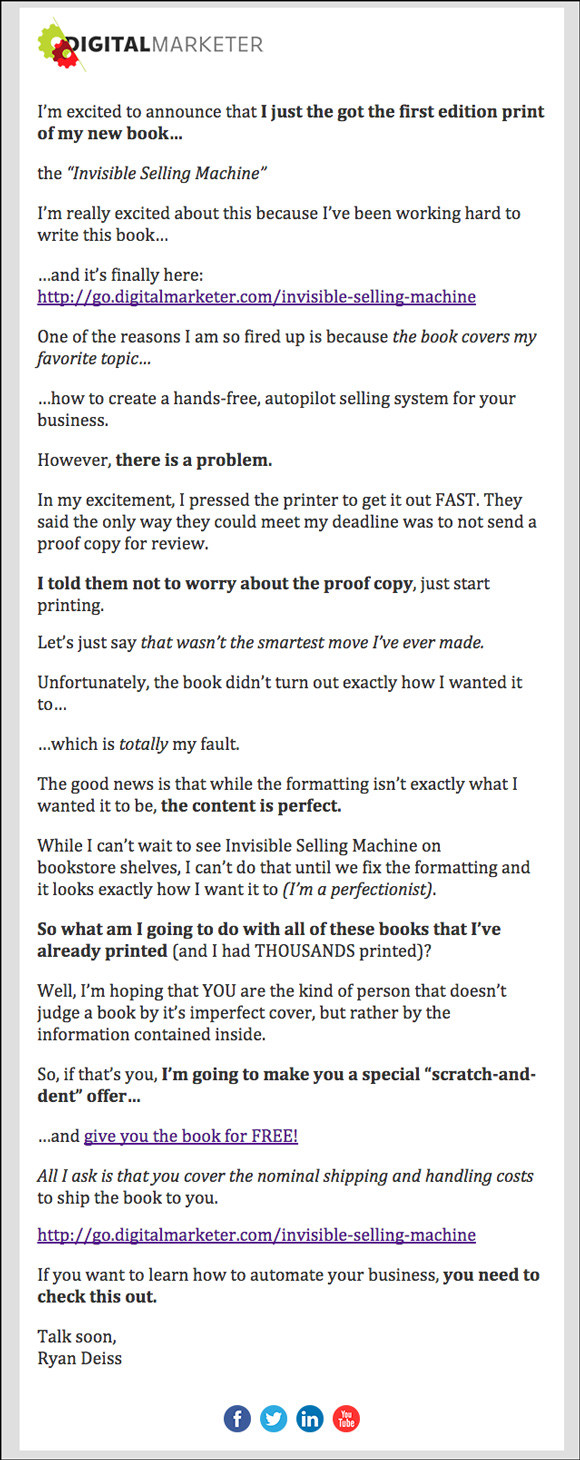
11. My new book! (and a big mistake) [16.14% CTR]


This email undoubtedly got a great open rate because it’s an admission of guilt or fault. When you’re an authority and you admit fault, you show a human side, people tend to relate to that and want to know what you have to say.

But what about the clicks?


First, it’s about Ryan’s first book. It’s something new, it’s an event.


The admission of failure is the second reason it got clicks. It’s not only an admission of failure, it’s a scratch-and-dent offer… a reason to have a sale.


The admission of guilt and the fact that it is an event really drove clicks.


Notice that the benefit was breezed over — there was almost detail on the content of the book or why you should read it.

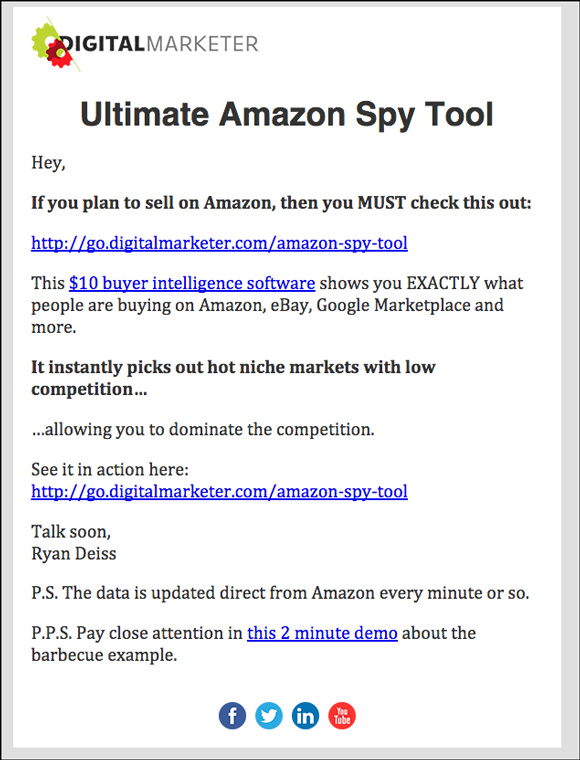
10. Do NOT sell on Amazon without this $10 tool… [16.56% CTR]


We did a lot of qualifying in this subject line but there’s a TON of curiosity in this email.


‘The Ultimate Amazon Spy Tool” — Just the spy tool or buyer intelligence software is enough to draw them in. Also, it’s a $10 tool. People love anything that’s going to automate their business.


Anything that creates speed & automation, or tools, in Digital Marketer’s vertical are great sellers. We’ve qualified a very low price point, and then went in and played up the voyeuristic aspect of spying on customers.


It also talks about a 2 minute demo in this last link. That’s a very passive link. It’s a demo video, not a sales presentation, so they already know the price and they’re just clicking over to see the demo.


This is a very passive email that worked really well.


9. Steal these email templates… [16.78% CTR]


#9 is about templates. (You’ll be seeing A LOT of templates winning the click in these emails!)


Going back to what was successful in the last email: it’s all about speed & automation. People love it.


Templates, software, tools.


This comes out of the gate with a benefit — “Want a way to double your sales?”


Then it’s just copy and paste these three emails.


So this email is gunning for the benefit: the template.


The screenshot also helped. It’s in Word; it’s recognizable. People aren’t going to be afraid of the software in this instance.


Easy to use, highly desirable.

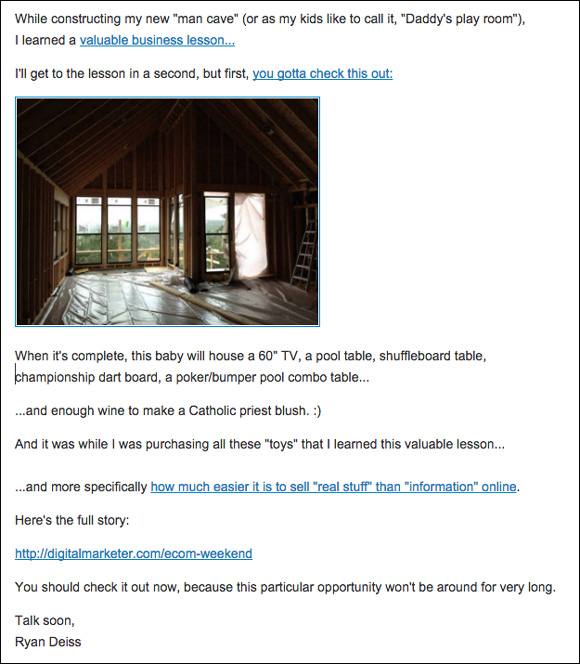
8. Check out new “man cave” [PICS] [18.09% CTR]


This subject line piques curiosity — the word “PICS” draws the reader in right away.


It’s also a story. A look into the personal life of the head of a company. It’s humanizing a big company.


Going into this it shows a very personal picture, ties it back into a story, and then talks about a lesson learned.


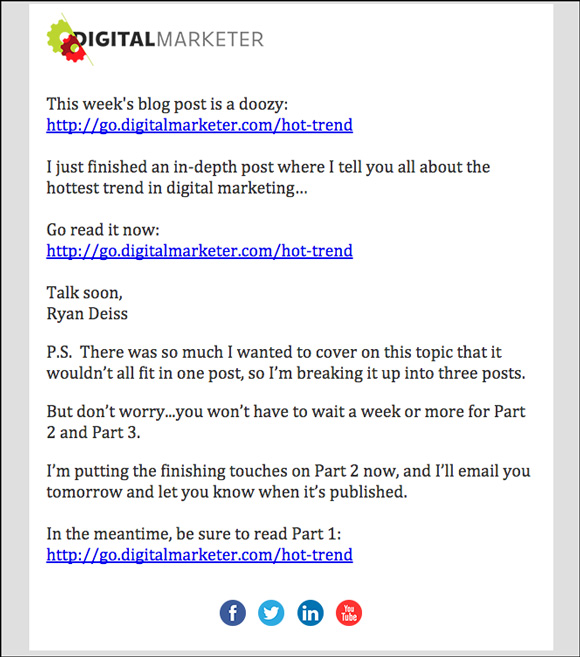
7. THIS is the hottest trend in digital marketing… [18.21% CTR]


This is a straight up curiosity based email subject line and body copy.


There is no mention of WHAT the trend is.


The curiosity based subject line will get a ton of opens. And, in this case, we continue the curiosity or “blind” nature of the email in the body.


The formula here is a quick sentence and then a link. Then you qualify a little more, and give another link.


The clicks come because the reader wants to know more about the “hot trend.”


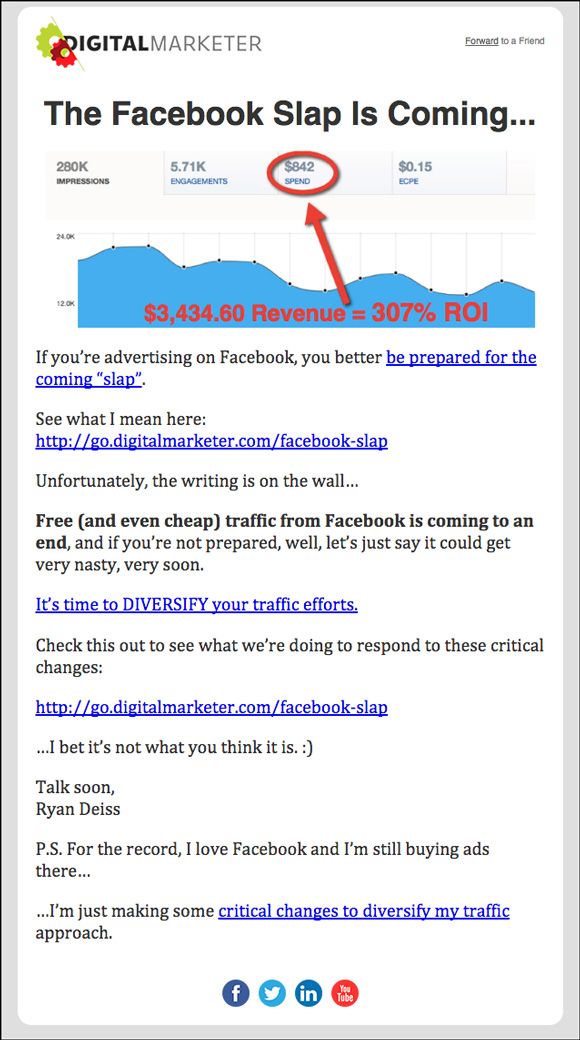
6. The Facebook Slap is coming… (swipe this) [18.25% CTR]


This email uses a lot of scarcity.


Not scarcity from a closing or traditional marketing-based scarcity… but a third party regulatory scarcity.


Here you have “The Facebook Slap Is Coming”… A slap is a well known term in this vertical. The “Google Slap” decimated marketers in every industry — and everyone was afraid of the imminent “Facebook Slap.”


This email played on those fears.


Anytime you can show proof elements visually in your emails, you’re going to explode your clickthrough rates.


That proof element right at the top of this email (the image) probably had a ton of clicks, and then the subtle scarcity of the impending slap drove people to click for more information.


This is pure scarcity based with a splash of fear mongering… but it does promise some critical information and it delivers once you’ve clicked through.


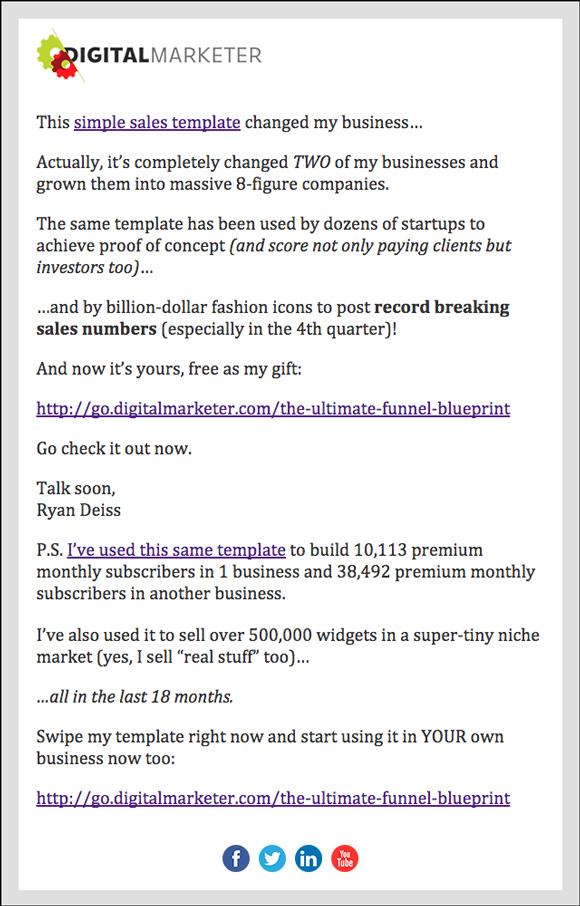
5. The 8-figure template… (swipe this) [18.91% CTR]


We’re back to templates.


If you’re paying attention to the trend, you’ll notice that speed & automation, and templates tend to get a ton of response.


This email is also fairly “blind” and curiosity based. It doesn’t say what kind of template it is exactly.


It’s a sales template but doesnt give much indication after that. There’s proof, the template factor, and the gift aspect.


The free gift almost always increases response.


It ends with a proof based P.S.


We do a great job of establishing the value of these templates with this body copy.


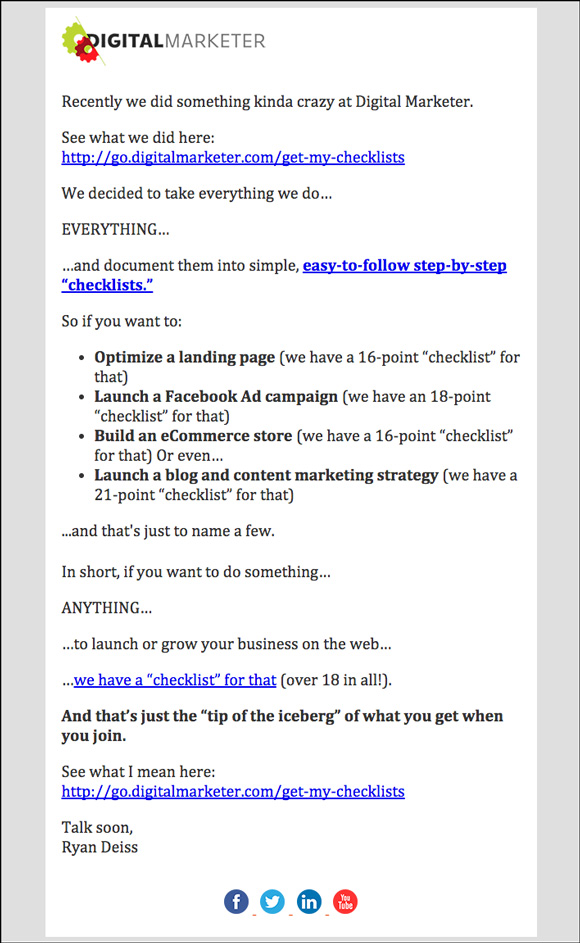
4. “Borrow” all my checklists… [20.33% CTR]


Exact same scenario — templates, checklists, tools.


These are things that we have of value that we’re giving away or selling.


So the beginning of this email follows the theme of curiosity based content.


We open with a quick statement — and then drop a link to grab everyone that knew from the subject line that they were interested.


People knew before they opened that email that they were going to click the link. You don’t want to talk too much — get your statement out and then a quick link. That’s a typical curiosity-based email.


Then, we give them another reason to click by giving them a benefit…


“… easy to follow step-by-step checklists.”


You either go proof or curiosity first, followed by proof or benefit second, followed by scarcity or proof third.


If you follow that linking structure, you’ll start to see really high click-through rates in your emails.


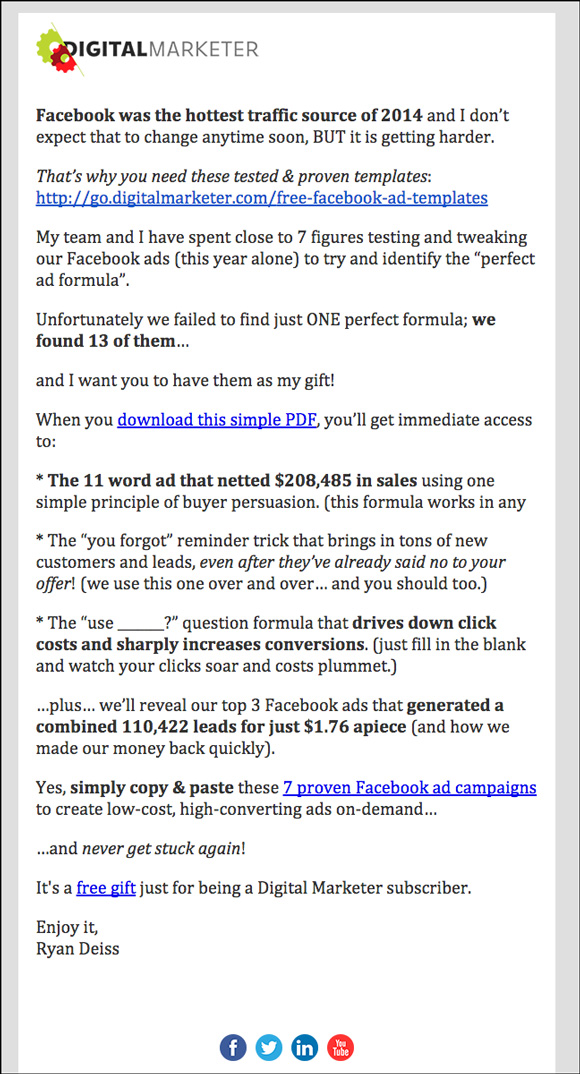
3. [SWIPE] My Facebook “templates” (13 of them) [21.02% CTR]


What a surprise… templates! (Are you on our list? You’re missing lots of free stuff if not!)


This is the theme of our best emails — people want the templates we use because they want the results that we get.


It follows the exact same format we’ve been referring to. In this case, it’s the proof. We have undeniable proof of Facebook as the hottest trend, we tested these templates.


2. Copy and paste these 72 headlines [Last Chance] [24.99% CTR]


Another day, another free template giveaway.


These are headline templates. Are you seeing the pattern? So far we’ve had sales templates, headline templates, email templates, and there’s a reason we keep doing them — they work.


In this email the download button really boosted the click-through rate. It’s a button in an email — you should be 100% utilizing CSS buttons within your own emails.


This particular button had ‘Download’ on it and it had an amazing CTR.


1. [DOWNLOAD] Ultimate Facebook Ad Template [25.01% CTR]


We’ve reach our #1… what do you know? It’s templates.


So out of our top 11, it’s safe to say 6 are template related and I could argue the efficacy of making the other emails swing back around to some sort of template.


What do you need to do? Figure out what the ‘templates’ are of your business. You need to figure out what people want so badly from your business that no matter how often you talk about them, they keep responding to your emails.


This email is a little curiosity-based, again talking about the entire library of ours — it’s free, it’s desirable.


It follows the 3-4 link format we use in most emails and it gives the market what they demand.


Now… let’s take a look at the content emails that got the most clicks.


Best Content Email Body Copy


Before we analyze the copy of our top content emails you should know this…


No amount of persuasive copywriting will save a content email if the subject of the content being promoted is not interesting to the reader.


As with sending promotional email, it’s all about the offer.


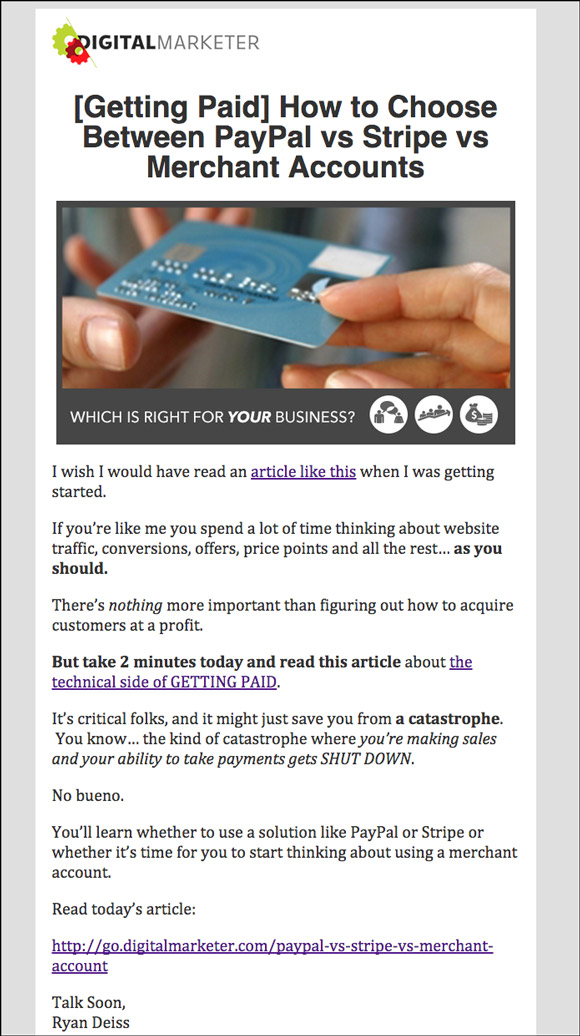
11. Subject: How to get paid [Literally] [16.51% CTR]


The email uses FEAR to get clicks… as it should.


The content on the other side of this click is, indeed, about something that could be catastrophic for the reader’s business. It would be foolish not to point out the danger involved in ignoring this content.


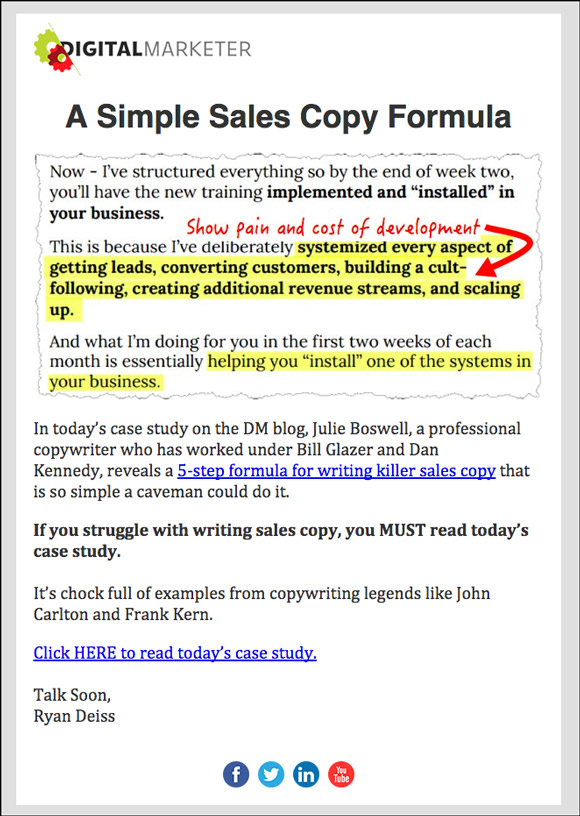
10. A simple sales copy formula [16.85% CTR]


This content email piggybacks off of the authority of recognizable names like Bill Glazer, Dan Kennedy, John Carlton and Frank Kern.


Add the references to ease of use in the headline (A Simple Sales Copy Formula) and lines like “so simple a caveman can do it” and we have a winner.


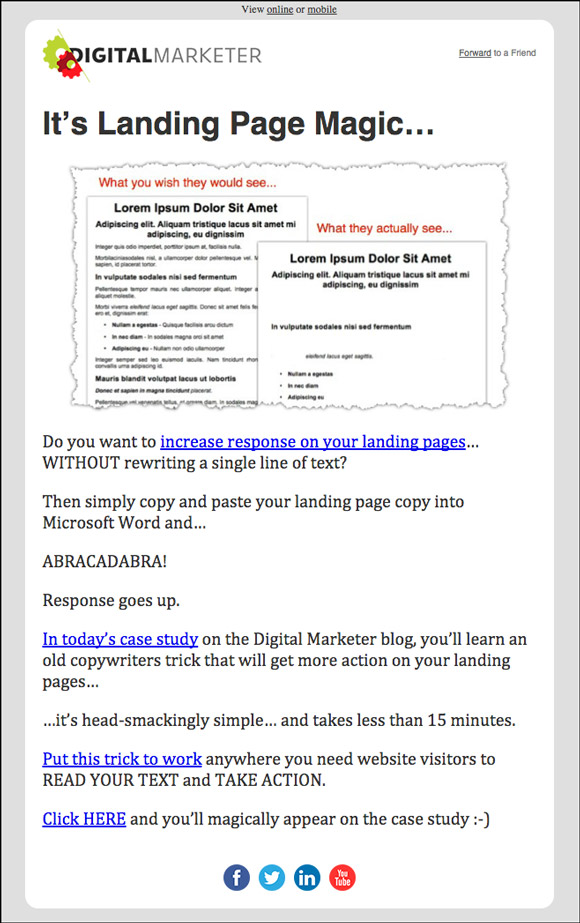
9. It’s landing page magic… [17.04% CTR]


This email has a simple formula: Get [desired result] Without [undesired result]


Do you see it? Here it is in the opening…


“Do you want to increase response on your landing pages WITHOUT rewriting a single line of text?”


8. How to write a promotional email [17.46% CTR]


This piece of content was created by a professional copywriter and this email leverages that authority to get clicks.


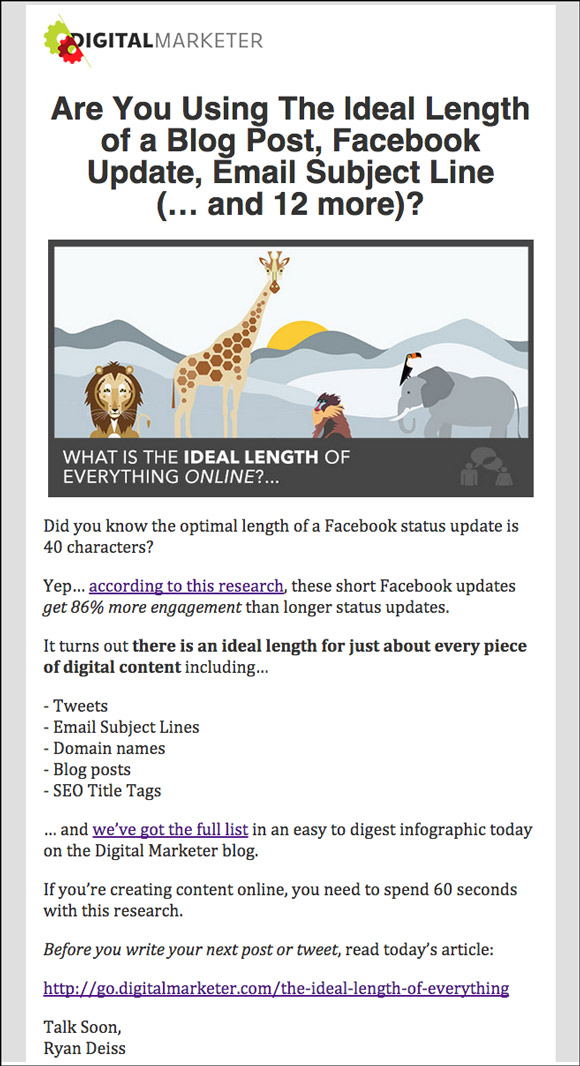
7. The ideal length of everything online [17.84% CTR]


This email is all about the offer. It uses a very direct subject line and body copy to direct readers to an infographic (offer) that we already KNEW they would want to see.


How did we know they would want this information?


Simple… we used a tool called BuzzSumo to find the most socially shared infographic on the subject of content marketing. In other words, the piece of content we are promoting was a proven winner created by the folks at Buffer. We simply embedded the infographic on our blog and shared it with our audience.


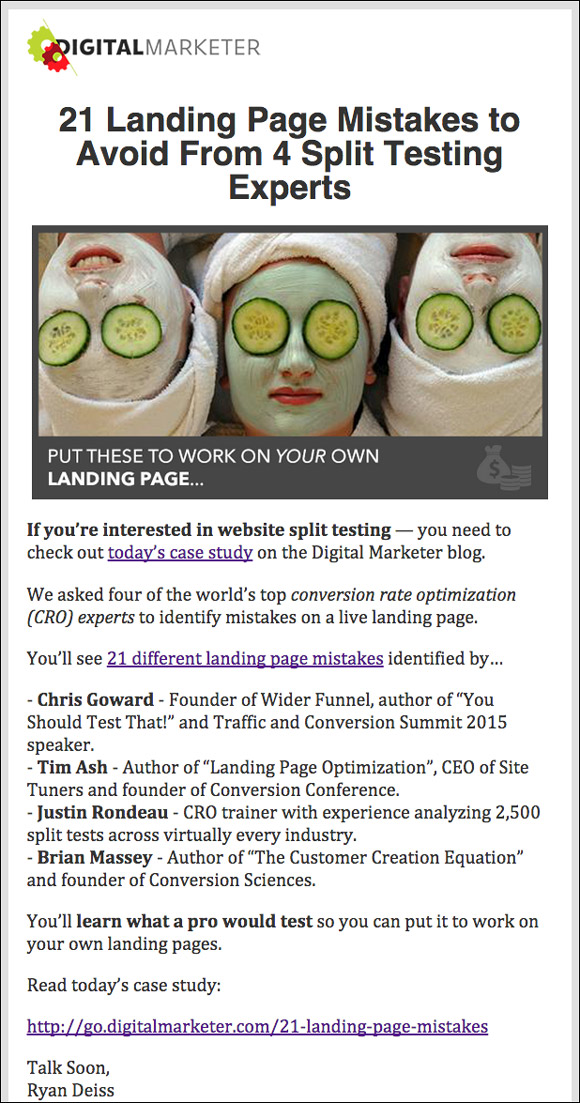
6. 21 landing page mistakes [18.28% CTR]


This email uses this formula: Learn to Get [Desired Result] From [World Class Expert(s)]


Do you see it? Here it is…


“We asked four of the world’s top conversion rate optimization experts…”


The email copy then proceeds to list those experts and their credentials.


5. 2015 will be a land grab (Get Yours) [19.88% CTR]


This email opens with a curious headline… “The Great Pixel Land Rush”


The copy remains fairly “blind” and emphasizes the speed of consumption with phrases like…


“You’ll learn about it in less than a minute”


Those that just wanted to read Ryan’s prediction really quick clicked on one of the first two links in the email. For anyone else still reading the email there is a “stack” of additional benefits bulleted toward the close.


It worked.


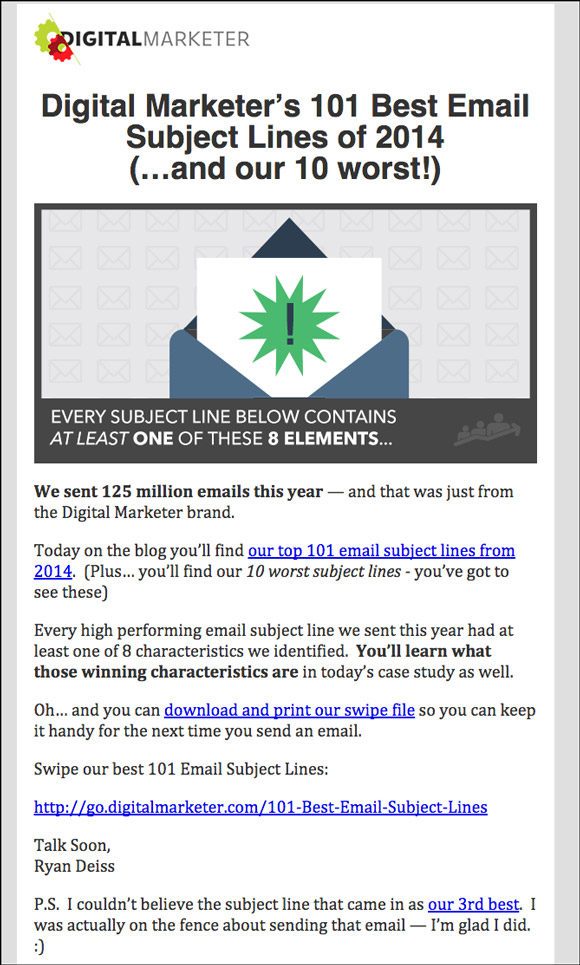
4. [SWIPE] Our best email subject lines of 2014 [20.97% CTR]


This is another email that performed well in large part because of the strength of the content it is promoting — it’s templates, swipe files, tools, etc.


Who would have thunk it?


The subject line and body copy are VERY direct .


The email opens with strong proof that we are an authority on email marketing. Then, the benefits are stacked on… 


Get our best 101 email subject lines 
Get our 10 worst email subject lines (Everyone loves a train wreck) 
Download our best subject lines as a PDF swipe file (<< this almost always gets more clicks) 


Then, in the P.S. we use curiosity…


“I couldn’t believe the subject line that came in as our 3rd best.”


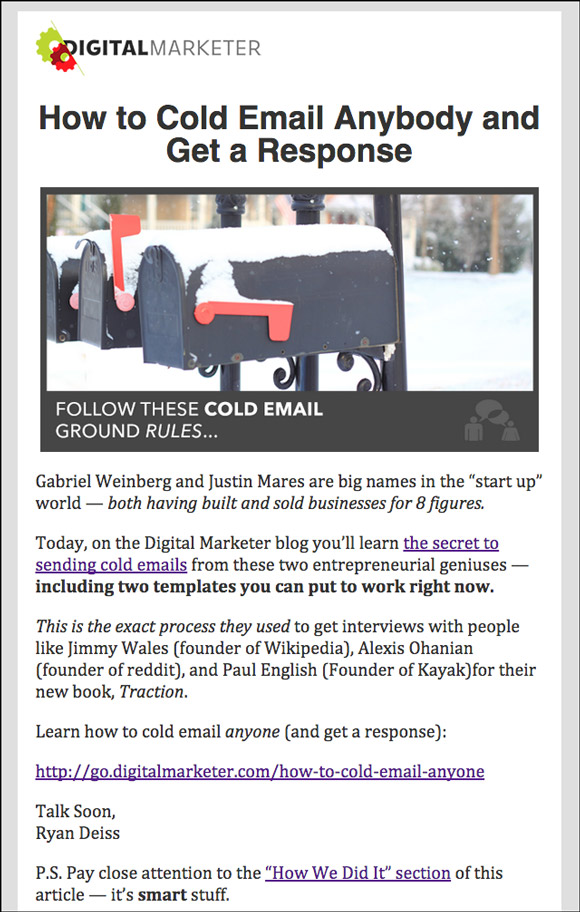
3. [TEMPLATE] Cold email anyone and get a response [21.52% CTR]


There’s a lot going on in this email…


The headline draws the reader in with a direct statement of benefit.


Then, the opening quickly builds proof and authority for the authors of the content with the line…


“… both having built and sold businesses for 8 figures”


Followed by a statement of benefit that promises something that everyone wants… The Silver Bullet in the form of a template… (go figure)


“… you’ll learn the secret to sending cold emails … including two templates you can put to work right now.”


Then, more proof is layered on with the statement…


“This is the exact process used to get interviews with people like Jimmy Wales (founder of Wikipedia)…”


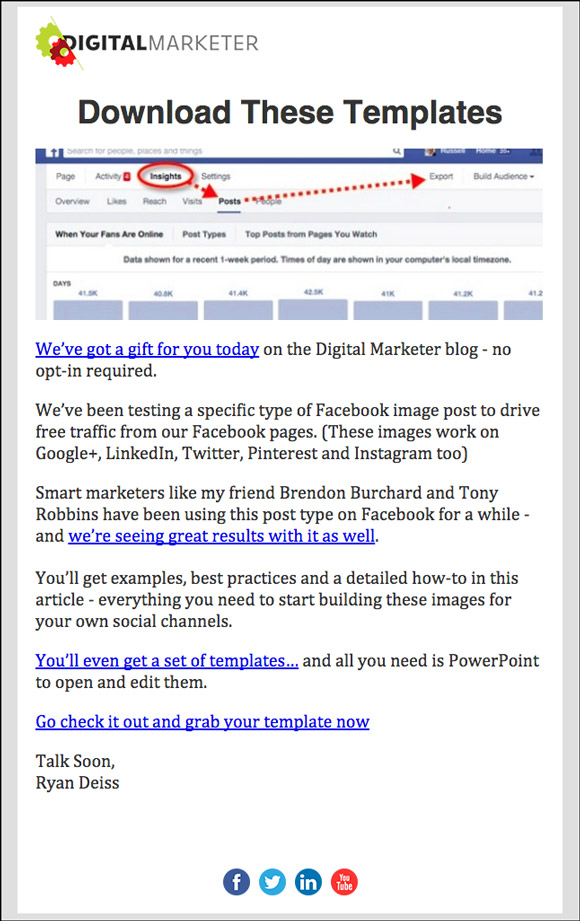
2. [TEMPLATE] Create engaging Facebook images [21.63% CTR]


Again… much of the success of this email is due to the offer.


The content (offer) is strong so the best route to take is to simply state the direct benefit of clicking.


This phrase…


“We’ve been testing a specific type of Facebook image post…”


… is important because it builds proof and gives the reader the sense that this something NEW.


And, notice that there is a promise of a useful resource to download and use. These downloadable resources are a recurring theme in many of our best content emails.


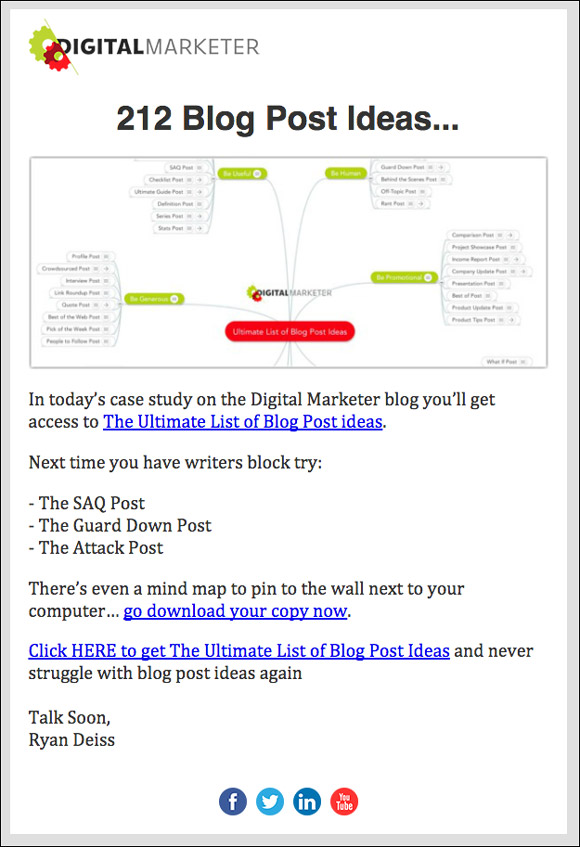
1. 212 blog post ideas [23.55% CTR]


Once again we have a downloadable resource available within this piece of content and the offer (content) is strong — in this case it is a mind map.


The offer is to get 212 blog post ideas and three of those blog post ideas are listed as bullets in the email copy.


Notice anything special about the three blog post ideas that are chosen?… 


The SAQ Post 
The Guard Down Post 
The Attack Post 


Yep… they are all a bit curious and new.


We could have chosen to feature the blog post ideas you already know about like The List Post, The Link Round Up, etc. but that would have almost certainly decreased clicks.


…and now the moment you’ve all been waiting for…


Our 5 biggest fails… (Tell me in the comments section why you think these failed)


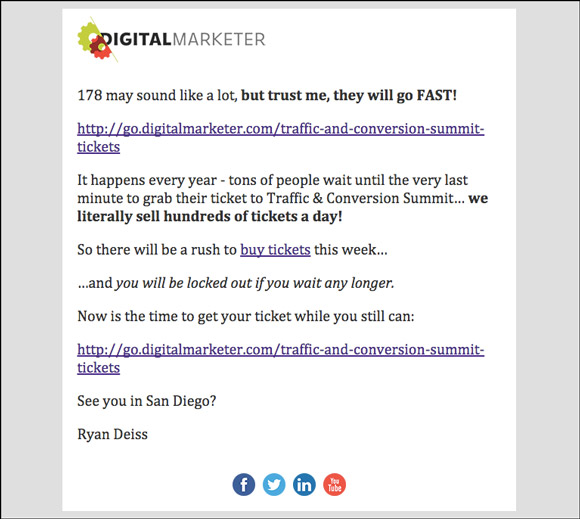
5. WARNING Only 178 T&C Tickets left… 2.34% CTR


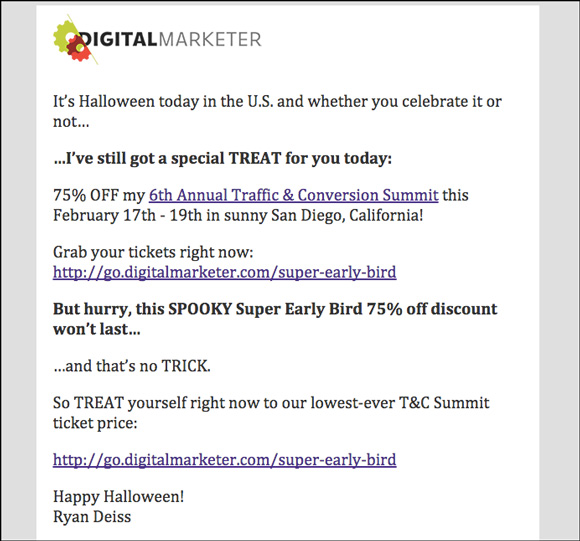
4. Spooky discount 75% off Conversion conference 3.79% CTR


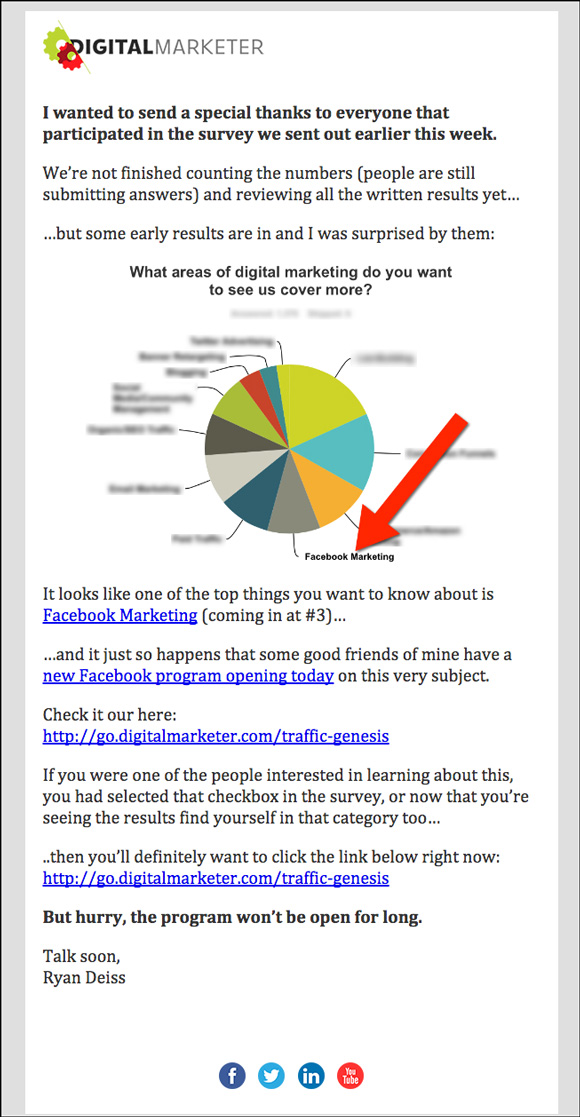
3. Survey Results (sort of…) 4.05% CTR


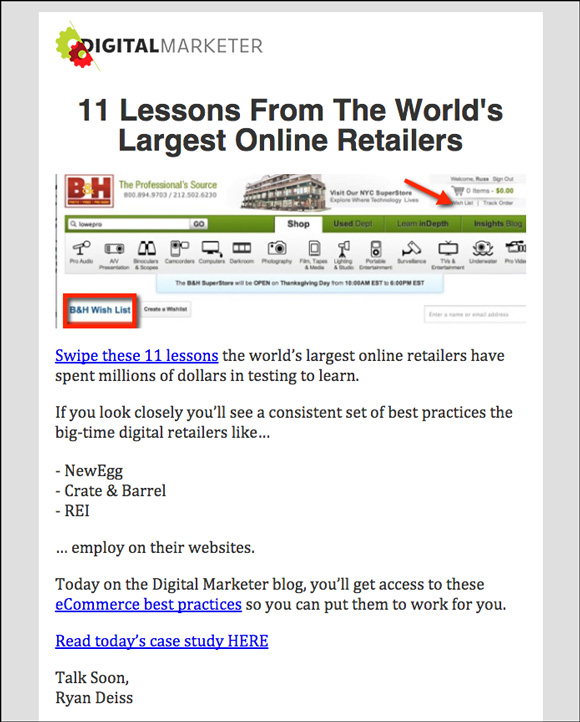
2. eCommerce Lessons from the Big Boys 4.91% CTR


1. Native Ad Hacks 6.17% CTR


And that’s it. That’s our best email body copy over the last 12 months.